Day one morning: Charminar and Mecca Masjid
Begin before the Old City lanes become busiest, reading Charminar as an urban crossroads and Mecca Masjid as an active place of prayer.
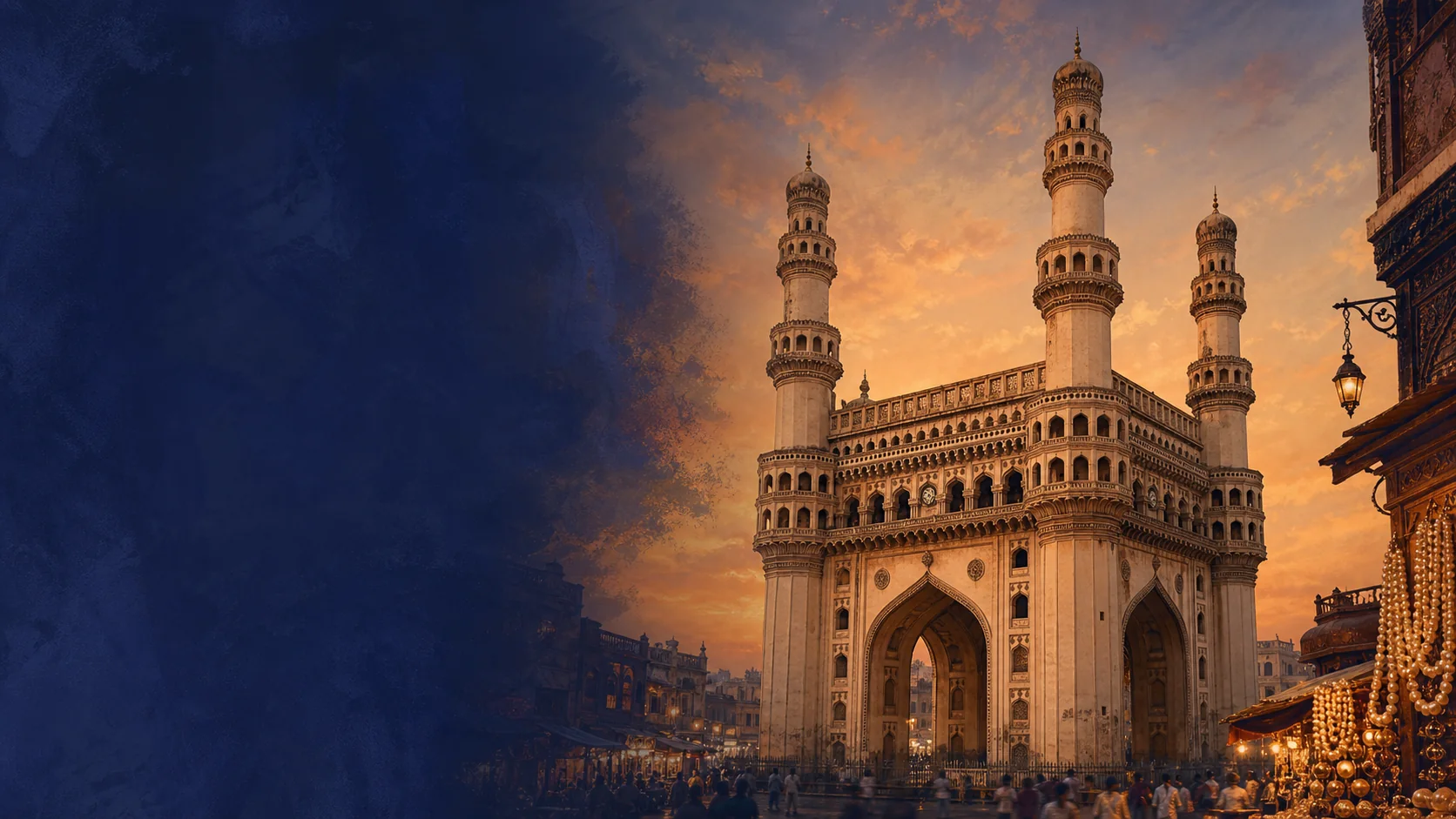
Charminar's four arches open directly into streets used by traders, worshippers, residents and traffic. The Hyderabad District guide provides the monument overview, but the entrance and upper-level procedure should be checked on arrival. Look outward from the structure to understand the planned city's axes rather than treating the façade as an isolated emblem.
Mecca Masjid stands beside this commercial centre and remains one of Hyderabad's principal mosques. The district visitor guidance asks guests to dress modestly, remove footwear where directed and maintain silence. Sightseeing must pause during prayer, and the courtyard should never become a staging area for group portraits that obstruct worshippers.
- Carry a scarf and clothing that covers shoulders and knees.
- Agree on a meeting point away from the monument entrance.
- Keep cameras lowered whenever prayer is under way.
Day one afternoon: palace rooms and Laad Bazaar
Continue to Chowmahalla Palace for Asaf Jahi court history, then browse Laad Bazaar without allowing shopping to overwhelm the heritage day.
Chowmahalla's courtyards, Khilwat Mubarak and ceremonial collections illuminate the Nizams' statecraft after the Qutb Shahi period. Hyderabad District maintains an official destination page, while the palace controls current admissions and photography. Read the sequence of public court, reception and service spaces instead of moving straight to the most ornate hall.
Laad Bazaar begins close to Charminar and is known for lacquer bangles, textiles and wedding goods. Ask before photographing artisans, clarify material and price before purchase, and keep pedestrian flow open in its narrow lanes. Food stops should be selected for hygiene and dietary suitability, not only for online fame.
- Confirm palace camera rules at the ticket point.
- Ask whether bangles are locally made when provenance matters.
- Step into a safe recess before checking maps or prices.
Day two morning: climb Golconda with context
Give Golconda Fort a cool morning and enough time to connect its gates, water systems, acoustics and hilltop citadel.
Golconda was the Qutb Shahi capital before Hyderabad developed around Charminar. Its successive gateways, granite defences and elevated palace remains require substantial walking and stairs. A knowledgeable authorised guide can explain the fort's defensive planning without relying on shouted acoustic demonstrations alone.
Begin at the lowest public entry and climb only as far as health, heat and current access permit. Carry water, use shoes with grip and stay away from unguarded edges. The sound-and-light programme, when operating, is a separate evening decision and should be verified through an official channel.
- Reach the fort before the strongest afternoon heat.
- Use marked stairways instead of eroded shortcuts.
- Agree guide scope and payment before entering.
Day two afternoon: Qutb Shahi Tombs
Move from the fort to the nearby royal necropolis, where garden planning and changing mausoleum styles deserve a separate visit.
The tomb complex at Ibrahim Bagh holds the mausoleums of Qutb Shahi rulers and members of their court. Domes, arcades, stucco and landscaped enclosures reveal dynastic memory in a quieter register than Golconda's military architecture. Conservation work may affect which structures can be approached.
Treat the gardens and graves as heritage requiring composure, not a backdrop for loud staged photography. Follow every restoration barrier, avoid sitting on tomb platforms and ask staff before using specialised camera equipment. If Golconda has exhausted the group, move this necropolis to the following morning.
- Check current conservation access with the Hyderabad District administration.
- Keep voices low around mausoleum interiors.
- Use the official entrance rather than a neighbourhood shortcut.
Day three: collections, lake or living craft
Anchor the final day at Salar Jung Museum, then choose either the central lake-and-temple area or Shilparamam in western Hyderabad.
Salar Jung Museum's decorative arts, manuscripts, painting and sculpture span Indian and international collecting histories. Its scale calls for a shortlist based on the official galleries. Afterward, Hussain Sagar and Birla Mandir offer a central-city finish, subject to temple dress, photography and worship rules.
Shilparamam in Madhapur suits travellers more interested in artisan work, performance and the contrast between craft traditions and Hyderabad's technology corridor. Check its official programme, buy directly from identifiable makers where possible and do not combine it with the lake if traffic would reduce both to hurried stops.
- Select museum galleries before arriving.
- Follow Birla Mandir's device and footwear instructions.
- Use Shilparamam's official calendar for performances.