Connect this guide with the rest of your visit in the Hyderabad trip planner. Read how the research is made and what its sources establish.
At a glance
Start here
- Begin with Golconda as a working fortified city, not only a hilltop view.
- Read the heritage park as tombs, mosques, stepwells, gardens and court memory together.
- Understand Charminar as the centre of a new city outside the fort.
- Describe the group accurately as being on India's UNESCO Tentative List.
01
See three sites as one historical sequence
UNESCO's Tentative List entry identifies Golconda Fort, the Qutb Shahi Tombs and Charminar as landmarks of the dynasty that ruled the region from the early sixteenth century until 1687. Each performs a different urban role. The fort contains defensive, residential, religious and water infrastructure; the tombs hold royal and court memory; Charminar announces the later city of Hyderabad.
The physical distance between the western fort landscape and the Old City is part of the history, not an inconvenience to edit out. Visit Golconda and the heritage park together, then give Charminar a different outing. This is an editorial sequence based on geography and historical function; it is not a claim that a visitor must follow one authorised route.
- Golconda: fortified capital.
- Heritage park: dynastic necropolis and water landscape.
- Charminar: ceremonial centre of the new city.
02
Read Golconda below the summit
The UNESCO description presents Golconda as more than ramparts: it includes gates, bastions and armoury alongside mosques, temples, palaces, courts, hammams, gardens and water systems. The district page likewise identifies a layered fortified settlement on a granite hill. A summit-only visit therefore misses much of the evidence for daily administration and life inside the capital.
Pause at gateways to ask what movement they controlled, look for changes between military and residential space, and notice how water had to move through an elevated settlement. Acoustic demonstrations are a small interpretive detail, not the whole fort. Follow official routes and accept closed areas; unguarded masonry, steep steps and conservation zones are not shortcuts to a better view.
- Give the lower gates and courts real time.
- Look for water, storage and residential functions.
- Turn back when heat, stairs or access conditions require it.
03
Understand a necropolis, not seven isolated tombs
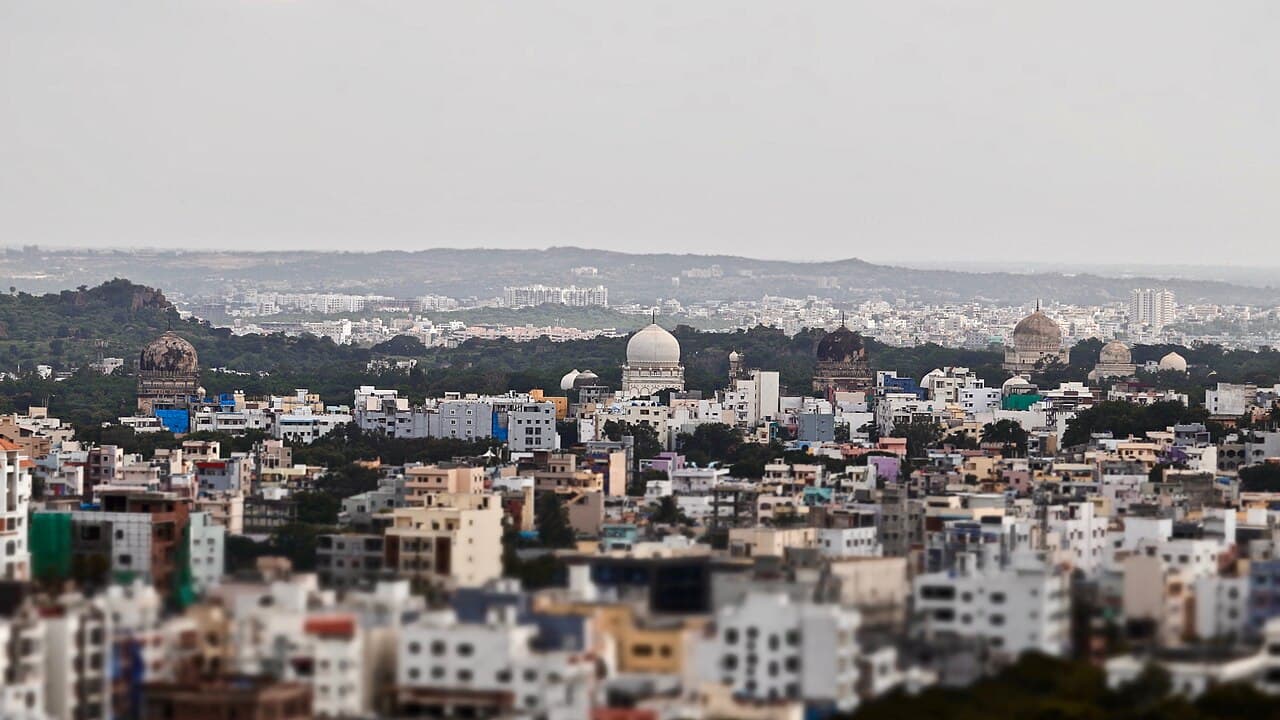
The current heritage-park site explains that the 106-acre landscape includes royal and court tombs, funerary mosques, graves, a hammam, stepwells and archaeological remains. Its visitor page notes that the popular Seven Tombs label understates the number of tombs and monuments. The useful unit of attention is therefore the whole funerary and garden system rather than seven domes on a checklist.
Begin with the founder's mausoleum, compare later forms and notice how smaller graves relate to monumental structures. Keep voices low and avoid treating grave platforms as seating or portrait stages. The park permits personal photography under stated rules, but commercial work requires permission and drones are prohibited. Recheck those rules on the current visitor page before bringing specialised equipment.
- Compare scale and plan across several mausoleums.
- Include funerary mosques and smaller graves in the reading.
- Stay behind barriers around monuments and stepwells.
04
Follow water through the heritage park
Stepwells are structural evidence, not decorative pits. The heritage park identifies six baolis and says restored systems collect rainwater for the landscape. Gardens, paths and water management help explain how a large funerary complex was maintained in the Deccan climate. The park's recent conservation story therefore includes ecological and landscape work as well as repaired stone and stucco.
Observe the stepwells only from designated visitor space, and never approach the water across a barrier. Look for levels, catchments and relationships between garden plots and monuments. Water levels, planting and visible runoff may change with weather and maintenance, so use current site interpretation rather than treating one day's appearance as the historic landscape's permanent state.
- Treat baolis as working water infrastructure.
- Notice grade changes between tomb terraces and gardens.
- Keep the water clean and remain behind protective walls.
05
Ask what conservation changed
The Qutb Shahi Heritage Park project states that conservation and landscape restoration began through a partnership involving the Aga Khan Trust for Culture, the Department of Heritage Telangana and the Quli Qutb Shahi Urban Development Authority. Telangana's 2024 completion-ceremony record confirms the public partnership and conservation of more than one hundred monuments across the park.
Do not reduce that work to a before-and-after beauty claim. Ask which evidence guided repairs, which traditional materials or crafts were used, how rainwater systems were restored and where archaeological remains remain deliberately legible. Fresh-looking plaster can be part of researched conservation, while a ruin may be retained because evidence does not support fuller reconstruction. On-site interpretation should settle specific questions.
- Read conservation panels before judging appearance.
- Distinguish repaired fabric from conjectural rebuilding.
- Treat active work zones as closed even if a path looks passable.
06
Arrive at Charminar as a new-city statement
UNESCO's description dates Charminar to 1591 and identifies it as a ceremonial gateway at the crossing of two arterial axes in Muhammad Quli Qutb Shah's new city outside Golconda. That urban role is visible in the four arches and the continuing market streets around them. The monument makes most sense after the enclosed logic of the fort.
Stand where public access allows and identify the directions opened by the arches. Then look beyond the structure to streets, worship and commerce. The surrounding district remains active, so this is not a controlled archaeological park. Keep Mecca Masjid access respectful, ask before photographing traders or customers, and accept on-site limits on entry to the monument.
- Read the four arches as urban directions.
- Compare open market streets with Golconda's controlled gates.
- Respect worship, trade and traffic around the monument.
07
Use the UNESCO label accurately
The Qutb Shahi monuments appear on India's UNESCO Tentative List. A tentative listing is an expression submitted by the State Party for possible future consideration; it is not the World Heritage List. The UNESCO page itself warns that publication does not imply a World Heritage Committee judgment. Calling the sites UNESCO World Heritage Sites would therefore be inaccurate.
The tentative entry is still useful because it explains why the fort, tombs and Charminar belong together and sets out the architectural case. Use it as an interpretive framework, then rely on current site operators for access, tickets and conservation closures. Heritage status, visitor hours and open routes are different kinds of information and should never be collapsed into one old caption.
- Say UNESCO Tentative List, not World Heritage Site.
- Use operator pages for current visiting details.
- Date any status statement when publishing or reviewing.
Useful answers
Reader questions
Are Hyderabad's Qutb Shahi monuments UNESCO World Heritage Sites?
No. Golconda Fort, the Qutb Shahi Tombs and Charminar are grouped on India's UNESCO Tentative List. That is not the same as inscription on the World Heritage List.
Sources: UNESCO World Heritage CentreWhy visit Golconda before Charminar?
The order reveals the historical sequence from fortified capital to the new city founded around Charminar. It is an editorial interpretation, while UNESCO's entry supports the different functions and relationship of the sites.
Sources: UNESCO World Heritage Centre; Hyderabad District, Government of TelanganaAre there only seven Qutb Shahi tombs?
No. The heritage park's current visitor page says the popular Seven Tombs label masks a much larger landscape of tombs, graves, mosques, stepwells, a hammam and other monuments.
Sources: Qutb Shahi Heritage Park; Qutb Shahi Heritage Park and Aga Khan Trust for CultureCan Golconda Fort and the heritage park be combined?
They are near each other and form a coherent western heritage cluster, but both require substantial walking and attention. Confirm current hours, begin with the harder outdoor priority and drop one if weather or mobility makes the combined plan unwise.
Sources: Qutb Shahi Heritage Park; Hyderabad District, Government of TelanganaRead the evidence
Sources and further reading
These sources support the relevant sections above. Plans and comparisons are editorial suggestions. Check operators for current arrangements.
- The Qutb Shahi Monuments of Hyderabad Golconda Fort, Qutb Shahi Tombs, Charminar ↗UNESCO World Heritage Centre · Research date 14 September 2026
Tentative List status, dynastic chronology, the three-site grouping and the distinct urban and architectural roles of fort, necropolis and Charminar.
- Qutb Shahi Heritage Park: A Journey Through Centuries of History ↗Qutb Shahi Heritage Park and Aga Khan Trust for Culture · Research date 14 September 2026
Park extent, monument types, conservation partnership, landscape restoration and traditional conservation approach.
- Discover Qutb Shahi Heritage Park ↗Qutb Shahi Heritage Park · Research date 14 September 2026
Current visitor rules, facilities, opening information, larger tomb count, monument range, stepwells and proximity to Golconda.
- Golconda Fort ↗Hyderabad District, Government of Telangana · Research date 14 September 2026
Fort location, hill setting, Qutb Shahi capital role and surviving military, religious, residential and service structures.
- Qutub Shahi Tombs ↗Hyderabad District, Government of Telangana · Research date 14 September 2026
Tomb landscape, Ibrahim Bagh setting, architectural forms and physical relationship with Golconda.
- Charminar ↗Incredible India, Ministry of Tourism, Government of India · Research date 14 September 2026
Charminar's Old City setting, four-arched form and current destination context.
- CM participated in completion ceremony of Qutb Shahi Heritage Park ↗Government of Telangana · Research date 14 September 2026
Government confirmation of the conservation partnership and 2024 completion ceremony.
- Department of Heritage Telangana ↗Department of Heritage Telangana · Research date 14 September 2026
The state department's current role in archaeology, conservation, protected monuments and museums.